PSFs (or the lack thereof) - a fix to unrealistic degredation modeling for different microscope modalities
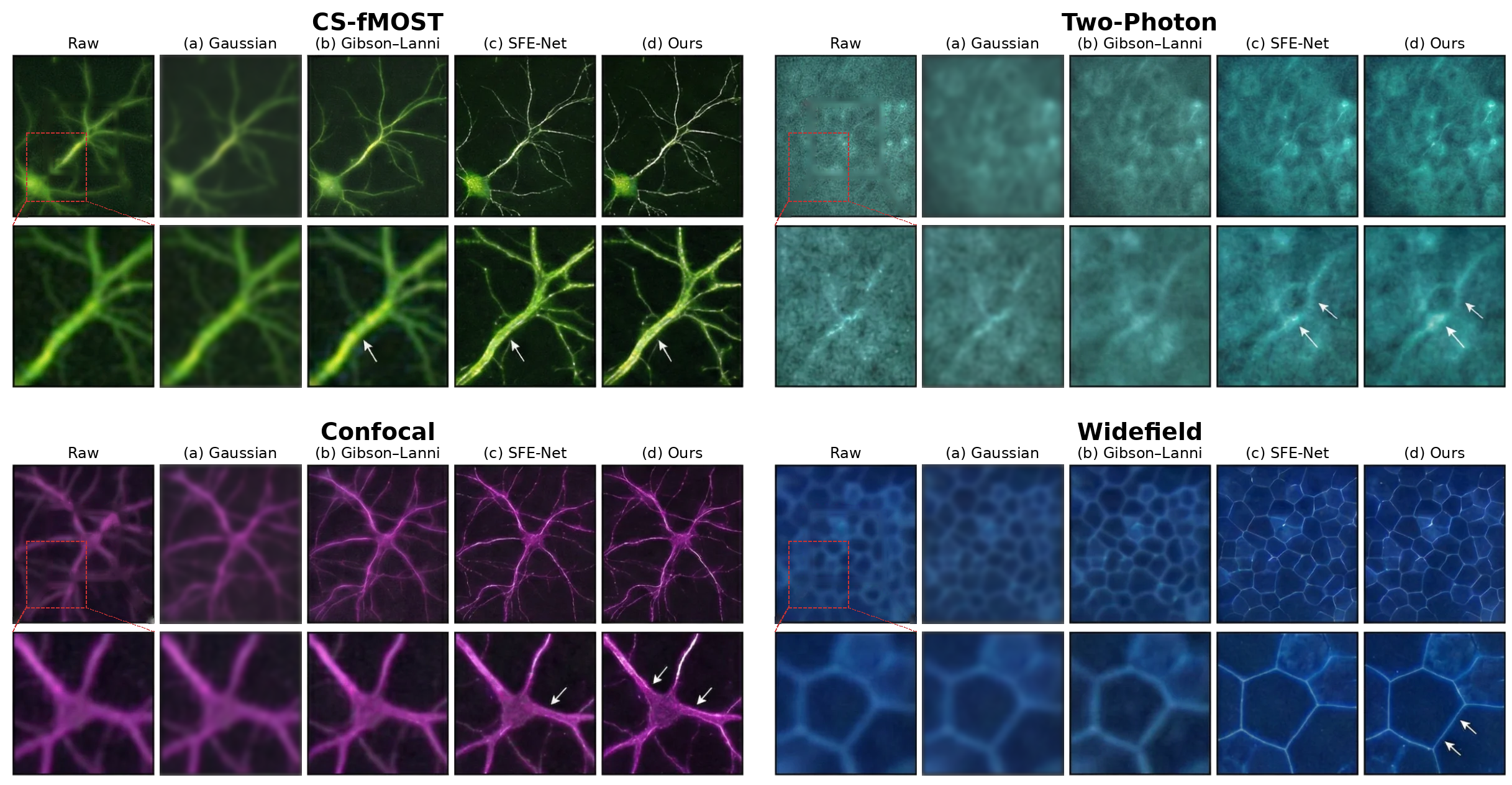
A few months ago, I knew pretty much nothing about photonics or microscopy. For my most recent project at CMU, I was tasked with developing a true, physics-informed PSF model which would, in theory, extract ground truth PSF kernels from XY images and predict what a 21x21 PSF kernel would look like for axial (XZ/YZ) slices. We ended up submitting to CVPR.
Existing literature on physics-informed PSFs showed me that current models were quite weak; even SOTA, like MIT's SSAI3D, assumed simple Gaussian blurring. Unrealistic parameters --> unrealistic PSFs --> unrealistic denoised images (because the noise itself isn't even accurate).
Our model expanded on physics priors, validated PSF estimates using bead-based measurements and Zernike coefficient plausibility checks, and improved downstream deconvolution (which showed fairly strong correlation (> .7) with prediction accuracy). This was ultimately integrated into our main denoising model.
All of this was done over the course of a month and a half, and I learned a lot about teamwork along the way. There's still a ton of work to be done regarding calibrating to different types of microscopy (two-photon, confocal, fluorescence) and further validating PSFs. I've come to learn computer vision is pwetty cool.
If the PDF doesn't load, refresh the page.